The Kerrang! Chart
The Kerrang! Chart: The best new music this week
The ultimate new music countdown – every Friday on Apple Music!
As twenty one pilots bring their breath-taking show to IMAX and cinemas via new concert movie More Than We Ever Imagined, director Mark C. Eshleman talks the importance of nerves, staying true to a vision, and why it’s perfectly acceptable to “let loose” during this week’s screenings…
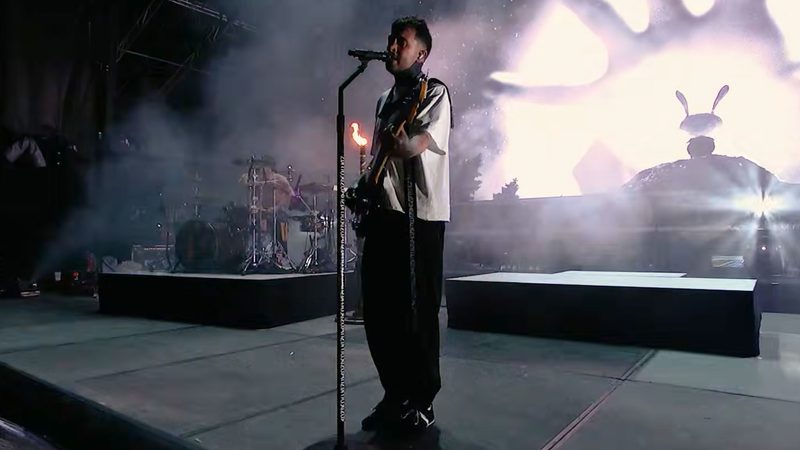
If you’re a stickler for proper cinema etiquette – no yapping or fidgeting, that sort of thing – then this week, twenty one pilots are here to loudly and colourfully say, ‘Screw that.’ The Columbus, Ohio superstars’ glorious new concert movie More Than We Ever Imagined opens worldwide on February 26, and singing, dancing, jumping and generally doing everything you can to revel in one of the biggest and best shows in rock is most certainly encouraged.
“The theatre is such a good spot to experience it outside of going to the actual show,” grins Mark C. Eshleman – aka Reel Bear Media – who directed the whole thing and has been the band’s closest collaborator since their very early days. “It’s different but it also feels the same: it’s loud, it’s energetic. We recently did a fan screening in Los Angeles, and everyone let loose and treated it like a concert. It was surreal!”
Filmed in front of 65,000 fans in Mexico City on last year’s stunning The Clancy World Tour, More Than We Ever Imagined isn’t just the culmination of this particular iteration of Tyler Joseph and Josh Dun’s mind-blowing onstage antics, but of the entire twenty one pilots story so far. And for once, rather than instinctively looking ahead to the future and wondering how they can one-up themselves for the umpteenth time, Mark is taking a well-earned second to relish it all.
“Seeing it with all those fans that it was made for, it was like I was able to watch it for the first time again – compared to watching it in a vacuum in post-production houses and on studio lots,” he explains. “We’ve never been good about celebrating our stuff – it’s always about moving on to the next thing. This is the first time I’ve kind of pumped the brakes a little bit and really enjoyed it. My fiancé, who I obviously talk to all the time when I’m travelling, she’s been telling me, ‘Don’t take this for granted’ – which I had no plans on! But she’s just been saying, ‘Really take a second to understand it, because this could go away at any time.’ It’s really nice to understand how important it is, and not just fly through it.”
Here, we get into the nitty-gritty with Mark – from taking TOP to the big screen for the second time, to the power of their incredible fanbase, and what it’s like seeing his pal Tyler scaling the roofs of giant venues all over the world, night after night…
It’s been five years since the Scaled And Icy livestream cinema experience, which quite frankly is still one of the coolest things twenty one pilots have ever done. More Than We Ever Imagined is a completely different thing, and released under very different circumstances, but how do the two compare for you?
“The cinema experience was interesting, because it was something that a lot of people had already seen at that point, and the only thing we changed is we added a lot of documentary footage into it. It also just reminded me of how important the show and live music was for us, because we created that in the vacuum of COVID. We went into an arena in Columbus and built a bunch of stages on the arena floor and captured the show that way. It was a cool experiment with Scaled And Icy being part of the lore, and what it meant to tell that story fit really well. But this feels so nice to have the fans involved. There’s a lot of fan interaction, where the band are going out or Josh is playing drums on top of the crowd. I think adding the crowd into it completely changed it for us. It felt like a true twenty one pilots movie experience, because the fans got to be involved.”
What was the vibe like on the day of the Mexico City show? It’s a high-pressure thing, but at the same time TOP are such a well-oiled machine at this point, so what were your stress levels like?
“I think I came in a little too prepared, for the first time in my career! I felt like it was almost to a fault. At that point I’d already seen the show, like, 30 times, and there was so much I wanted to get. Going through rehearsal the day before the soundcheck, we recorded some close-ups of Tyler and Josh, just to kind of put cameras where we can’t during the show. And the morning of the show, I took a deep breath and I went to every camera operator and talked to them and said, ‘This is your zone, and I want you to feel like you’re an artist. You’re here because you are creative and I want you to bring your flavour.’ I also told them to pretend their cameras weigh thousands of pounds, so there’s these big, long pans just to make it feel more digestible on the IMAX screen specifically – there’s not all these big camera swings and moves like that.
“I was able to go through and realign with all the camera operators and calm the nervousness, and more focus on the fact that we have the coverage we need, so let’s just shoot the show the best we can, and kind of not worry about the choreography as much and just feel the room. At the end of the show, I went to up the band’s manager Chris Woltman and just gave him a big hug, because it was an overwhelming sense of thankfulness and just love for the project, and love for the execution by the team. To see it all come together after the show, I was just gushing.”
Something Tyler talks about in the movie is the twenty one pilots crew – how much everyone cares, and how important you all are. Has that been a really satisfying part of this for you, building and putting together a proper dream team?
“Yeah, Tyler and Josh operate on a lot of loyalty – anyone that wants to stick around can stick around. And I think everyone that proves themselves worthy are always in the non-negotiables. We had the same core team for the last 15 years, and this movie kind of leans into that. But the biggest thing I want creatives to take away from it is that there was nothing special that happened for the band as far as the production side. It’s two guys that knew how to put on their show. In the early days, they were very concerned that there was some sort of step that they needed to climb up, or someone needed to reach down and pull them up, or they needed to buy some sort of backing track software or some sort of production thing. But, really, when it came down to it, every time they tried to do something that they thought was more ‘professional’, it backfired. What it comes down to is them being themselves – that’s the most important part of the entire process. The way they put on their show, it’s grown with them and it’s become evergreen, and I think that’s important for creatives to see, because whenever we want to be creative in a capacity that’s larger than the state we’re at in that moment, we think that there’s some sort of formula or something that we’re not getting. But, really, it’s the stubbornness and obsession that got them to be where they are.”
Do you apply that same logic to yourself? You could easily spend a fortune on fancy cameras and equipment, but deep down all that matters is your vision…
“There’s this vicious cycle that happens where you make something you’re really proud of, and then you try to figure out how to make it even better, and you buy different gear or you experiment with lighting and all this stuff. And then you find yourself getting confused, and you start to lose that obsessive part that made you such a good creative in the beginning. A lifelong friend of mine came over to my house recently and we watched an old movie we made when I was just getting into college in 2007. We sat there and watched it, and it was not good! It was a really crappy camera we used, but what I saw was just me just trying to figure it out, trying things and doing stuff that I really wanted to be doing at the time. And I don’t want to ever lose that.
“When I did my first tour with the band, I had a little Canon digital camera with a 50 millimetre lens – that’s all I had, and I did the whole Regional At Best tour and video series with it. Whenever you start to add gear and more crew and more possibilities, you start to lose that connection with your ignorant self that was just creatively chomping at the bit to do something. You start to get a little bit like everyone else, and you’re trying to be someone that you’re not. That’s a long-winded response, but I’ve been thinking about that a lot, and I don’t want to lose that guy who didn’t know how to do it, but knew that he had to do it.”
Speaking about obsessiveness, such a memorable part of The Clancy World Tour is going out and filming the fans every single day for the intro to The Judge. What’s it like for you when Tyler comes to you with an idea and it’s like, ‘This adds to your workload and will probably be a bit of a pain in the arse, but it’s really important to the show…’?
“Pain in the ass is so funny (laughs), because it is nice to just wake up, get off the bus, roll into the venue, eat lunch and then sit in my office until showtime. But that whole process of filming the fans really reminded me and our second shooter Mase – the tour photographer Mason Castillo – that it’s really easy to just go into an arena that kind of looks like yesterday’s arena, put on the show and then leave. But when you’re going out into the line, you’re really reminded of the life force of this show: the fans. I mean, in the movie, Tyler and Josh are looking at the fans as they drive to the venue and they talk about how cool it is to see the line and what they represent, and what’s going to happen in the stadium that night. It definitely realigned the purpose of the show, and it made us all feel completely in it, and it made every show feel different. Even though it’s the same set, and the arenas all kind of look the same, and the choreography is all the same, having it filled with such different people kept that tour very fresh for us.”
How much do you enjoy the logistics – in the movie, Tyler’s running back to the stage after Car Radio and that moment above the venue is being captured, and then he’s coming back on the scooter. Do you really enjoy that stuff of being like, ‘Okay, here’s where we can do this, here’s where the cameras need to be,’ or is it a massive headache?!
“I love that stuff! I think preparation is the key to a show that’s worth a damn, you know what I mean? The band rehearses in person for a very short amount of time – all of the work is kind of done on the front end, working at home, planning, the Zoom calls, everyone getting on the same page. Tyler Shapard, the lighting designer, he does countless hours with Tyler just talking about the logistics of the show. You know, there’s that line in Backslide about ‘drowning in logistics’, and I think it’s tongue-in-cheek because he loves that part. He gets up there on the first day of rehearsal, everyone gathers around, he has a microphone and he talks for two-and-a-half hours and walks through the set. And I think that’s what makes a good show: the preparation. Being so rehearsed kind of opens you up to having a better and more connective show with the fans, because everything else is figured out. The setlist isn’t changing, we know all the transitions, and that opens up their brains to project into the crowd because they’re not distracted by all the other aspects.”
We see Tyler decide on the day that he wants to do the Car Radio reveal on a building on the other side of the venue, instead of where it was originally planned. During the show is that a heart-in-mouth moment for you, and have you had many of those throughout the years where you’re like, ‘Oh god, please let this go well’?!
“Oh yeah, and I think that’s what keeps us exciting for us. I mean, back in the day, when the band was really trying to be seen before any kind of radio success, Tyler would figure out a place to climb up a festival stage. There was plenty of times where he’d just run across all the vendors’ tents or the little buildings on the outside. There was a whole tour where they were the first of a three-band bill in 2013, and even though they only had a 25-minute set, they were like, ‘How can we do something that’s going to make us nervous to walk onstage, and hope that it’ll work out?’ I think that’s what keeps us excited – you have to have those moments or you’re gonna start phoning it in. It’s gonna be boring, and people are gonna sniff that out.”
You’ve been there for every single scale of show – is something like Mexico City your favourite to capture, or do you prefer some of the really tiny ones?
“I get really excited about capturing the story in the moment – that sounds pretty pretentious and makes it seem like I’m some sort of artiste! But [last year] they did an underplay in Los Angeles, and it was a no-cellphone show. And that had its own story, and was really captivating. Then there’s something like a stadium where everyone has their phone out, but they’re all jumping and being in it, and it’s all about the massive pit and the stands and the scale. That’s a different story, too. So I feel like every show is a different story to capture, and the contrast of all these different rooms over the years has been pretty captivating for me, because it changes so often.”
Every song is its own performance and has its own vibe, but what’s your personal favourite moment from the set?
“Anytime the band walks out and interacts with the fans is my favourite. I think Ride in particular that night was special. And the band brought a fan up onstage to sing the last chorus – the fan who did it that night was really funny. She was so sweet, and just to see her eyes kind of light up when everyone was chanting her name was really, really nice. And then of course the big finale of Trees, and being able to get a drone over top of that pit – which you can see in the trailer. It just looks unreal, it’s an amazing moment.”
Did Tyler and Josh come into it at any point in the editing process – were you showing them constant updates, or do they just leave you to it and then come back right at the end?
“Tyler used to specifically come over for that stuff – like for Drum Show, I directed that music video, and I would do a first pass and then he’d come into my office at home and sit there next to me and pretty much look at every take. Every music video we’ve ever done has been co-edited by the band. But this, for the first time ever, we had a bunch of really captivating footage and then they kind of just left me to it. And it wasn’t because they weren’t interested – it was like, ‘You know what, we’ve always trusted you and you have an amazing team with you, so go for it and make it happen.’ We showed them a first-pass and watched it on a TV at Josh’s and there was a note or two but they’re like, ‘Yeah, great,’ because it leans into all the aspects that I’ve learned about presenting their band. The whole thing felt like an exercise for me to prove to them that I’ve been paying attention for the last 16 years!”
You’ve been able to do so much together and it must have all been incredibly creatively fulfilling, but is there anything left on the bucket list for you personally? Having two films in the cinema must be pretty much at the peak…
“I mean, they’re always gonna find something that’s gonna be a challenge, and that’s gonna be the next big project. I would be really interested to see Tyler and Josh write a narrative piece. I think they’ve proven with the lore of Trench and everything they’ve done with the Bishops and Clancy and Torchbearer, even though the music is first, it’s so well thought-out and constructed. So yeah, I’d love to see them do full narrative, and if they want me to keep me on to direct something they write, that would be the next big thing – I think they’ve learned enough over the years that they could pull that off!”
More Than We Ever Imagined lands in IMAX and cinemas globally on February 26. twenty one pilots return to the UK to headline All Points East in London on Sunday, August 30.
Read this next: